
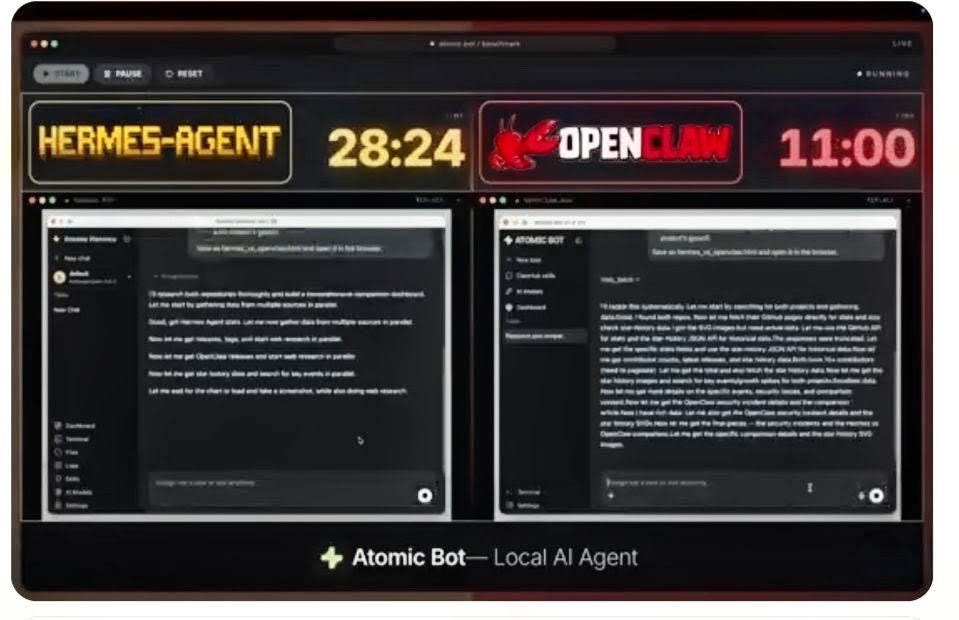
Hermes vs. OpenClaw: Atomic Bot Tests
Atomic Bot conducted a fascinating benchmark test involving two AI coding agents—Hermes and OpenClaw—pitting them against one another in a direct comparison. The experiment utilized a large language model, Qwen 3.6 35B, to assess how effectively each system could execute a real-world software engineering task. This experiment was not limited merely to generating snippets of code; instead, it tested the agents’ comprehensive ability to execute the entire workflow, from initial analysis through to final deployment.
The task assigned to both AI agents involved analyzing the history of a GitHub repository, identifying sudden spikes in activity, and creating a live dashboard capable of running directly within a web browser. This undertaking required sophisticated logic and involved multiple stages of execution, thereby establishing this benchmark as a robust test of autonomous coding and workflow orchestration capabilities.To ensure fairness, both Hermes and OpenClaw operated under identical conditions. They utilized the same underlying AI model, received the exact same prompt (instructions), and were assigned the same ultimate objective. By eliminating variables related to the model’s inherent capabilities, Atomic Bot’s objective was to compare the functionality and workflow orchestration quality of the two agent frameworks themselves, rather than simply comparing the performance of the language model.This benchmark evaluated three primary metrics, which are becoming increasingly critical within the field of AI coding:
1. Time Taken to Complete the Task
One of the most significant factors assessed was the speed at which each AI agent could complete its assigned task. Speed is paramount because developers and enterprises seek AI systems capable of accelerating project timelines and efficiently automating workflows. Rapid task completion often indicates superior planning, fewer errors during execution, and better workflow management.
2. Token Usage
Atomic Bot also measured the number of tokens consumed during this process. Token efficiency is crucial because the cost of utilizing AI is often directly correlated with token consumption. An agent capable of completing complex tasks using fewer tokens can prove to be significantly more cost-effective for developers and businesses operating at scale.
Google Search Outage on May 12, 2026: Millions Hit by 500 Internal Server Error Read also
3. Quality of the Final Dashboard
The final—and most critical—metric was the quality of the generated dashboard. Both agents were tasked with delivering a functional, browser-based interface capable of visualizing GitHub development trends and sudden spikes in activity. This exercise tested not only their coding proficiency but also their capabilities in data handling, frontend rendering, debugging, and task coordination.This experiment signifies a major paradigm shift within the field of artificial intelligence. AI systems are evolving beyond traditional chatbots and autocomplete assistants into autonomous agents capable of managing entire engineering workflows. Rather than merely answering queries or generating isolated code snippets, today’s AI agents are expected to analyze requirements, write code, debug errors, process data, and deploy functional applications.Benchmarks such as the Hermes vs. OpenClaw comparison are vital because they provide insights into how these agent systems perform within actual development environments. Real-world software engineering involves a multitude of interconnected tasks, and successful AI agents must be capable of navigating the complexities inherent in the various stages of the development lifecycle.This comparison also highlights the intensified competition within the AI agent ecosystem. Open-source and commercial developers are racing to build smarter, autonomous systems capable of boosting the productivity of programmers, startups, and large enterprises alike. Features such as workflow orchestration, memory handling, debugging strategies, and browser automation are emerging as key differentiators among AI agents.Leveraging the same Qwen 3.6 35B model, Atomic Bot established a controlled testing environment focused exclusively on the quality of work output. This helps developers gain a better understanding of which frameworks are the most reliable, efficient, and production-ready.As AI-powered coding tools continue to evolve, experiments of this nature could shape the future of software development workflows. Developers are now seeking AI systems that function not merely as coding aids, but as comprehensive engineering assistants. Hermes and OpenClaw represent a part of this accelerating trend toward autonomous, AI-driven development.