
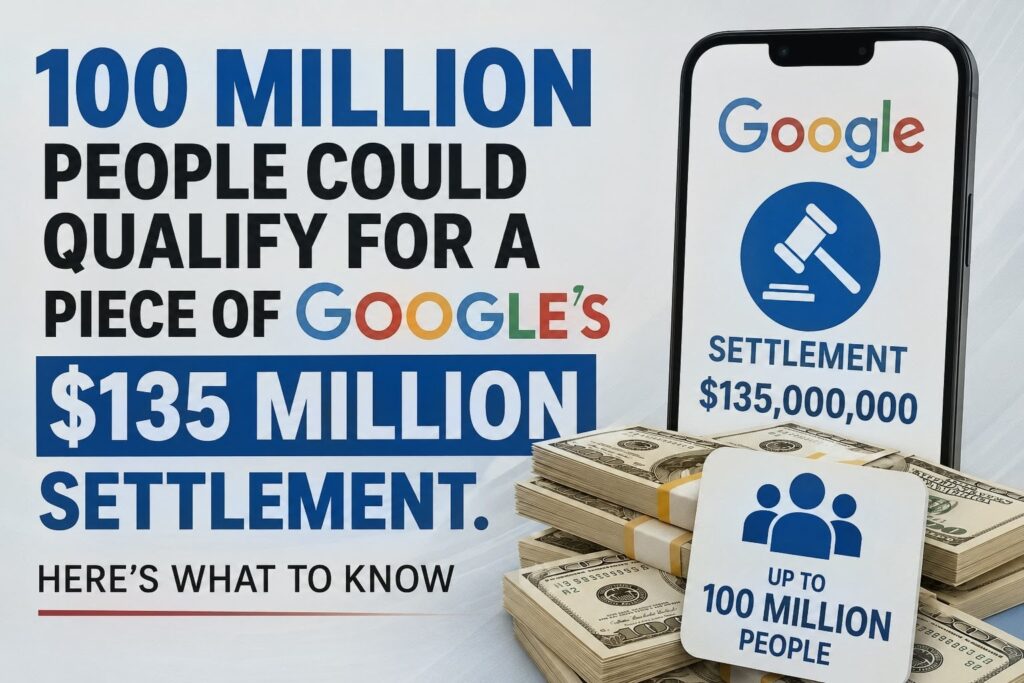
Source : Ai image
Google’s $135 Million Settlement
If you’ve used an Android phone in the U.S. since 2017, there’s a good chance you’re owed a piece of Google’s latest class-action settlement. Here’s everything you need to know before the deadline.
Google has agreed to pay $135 million to settle a class-action lawsuit alleging that its Android operating system secretly collected and transmitted user data without permission — even when apps were closed and location-sharing was disabled. The settlement is one of the largest in terms of sheer reach, with an estimated 100 million Americans potentially qualifying for a payout.
How to Create YouTube Thumbnail using AI (step-by-step Guide 2026 )
What Was Google Actually Accused Of?
The lawsuit alleged that Google deliberately engineered Android to continuously harvest user data in the background — collecting device information, location signals, and usage patterns in real time, without explicit user consent. Plaintiffs argued this amounted to “conversion,” a legal term for when one party takes another’s property without permission.The core claim: every time Android silently pinged Google’s servers, it consumed users’ cellular data — essentially forcing people to unknowingly pay for their own surveillance. Google has denied any wrongdoing but agreed to the $135 million settlement in January 2026, which received preliminary court approval on March 5, 2026.
Who Qualifies?
Eligibility is broad. You may qualify if you meet all three criteria:•You are a U.S. resident •You used an Android device to access the internet via a cellular data plan •You did so at any point since November 12, 2017There is one important exclusion: California residents who were already compensated through a separate $350 million Google settlement (the Csupo case) are not eligible for this payout.If you’ve owned an Android phone on a data plan in the last seven-plus years, you almost certainly qualify.
How Much Will You Actually Get?
Here’s where expectations need to be managed. The maximum individual payment is capped at $100 — but that’s an upper ceiling, not a guaranteed amount.After attorney fees (up to 29.5% of the fund, plus $750,000 in expenses) and administrative costs, the estimated net settlement fund drops to approximately $85 million. Divide that across 100 million eligible claimants, and the realistic per-person payout lands somewhere between $1.01 and $1.48.However, if a large portion of eligible users don’t register their payment preference, the remaining funds could be redistributed — potentially pushing individual payouts higher, up to the $100 cap.
Do You Need to File a Claim?
No — and this is the part most people miss. Payments are automatic. You do not need to submit a claim form or provide proof of eligibility.That said, you do need to select your preferred payment method to guarantee you actually receive your money. Eligible users who were notified via mail or email will receive a Notice ID and confirmation code. Use these on the official settlement website to register your payment preference.Accepted payment methods include Zelle, PayPal, Venmo, ACH bank transfer, and Virtual Mastercard.If you were notified but take no action, you “run the risk of not receiving a payment,” according to the settlement website.
Key Dates to Know
•Opt-Out / Objection Deadline: May 29, 2026. •Final Approval Hearing: June 23, 2026. •Settlement funds are already being set aside — Google was required to deposit the full $135 million within 45 days of the March preliminary Approval no funds revert to Google under the settlement terms.
Conclusion
Is $1 worth your time? Probably not on its own. But the Google Android settlement matters beyond the payout — it’s a formal legal acknowledgment that background data collection practices have real costs for users, and it forces Google to update its disclosures and privacy settings as part of the injunctive relief terms.If you’ve received an email or letter with a Notice ID, take two minutes to register your payment method. The deadline is today — May 29, 2026 — and the final hearing is June 23. After that, whatever isn’t claimed gets redistributed to those who did register.Check your inbox. That notification you ignored might actually be money.